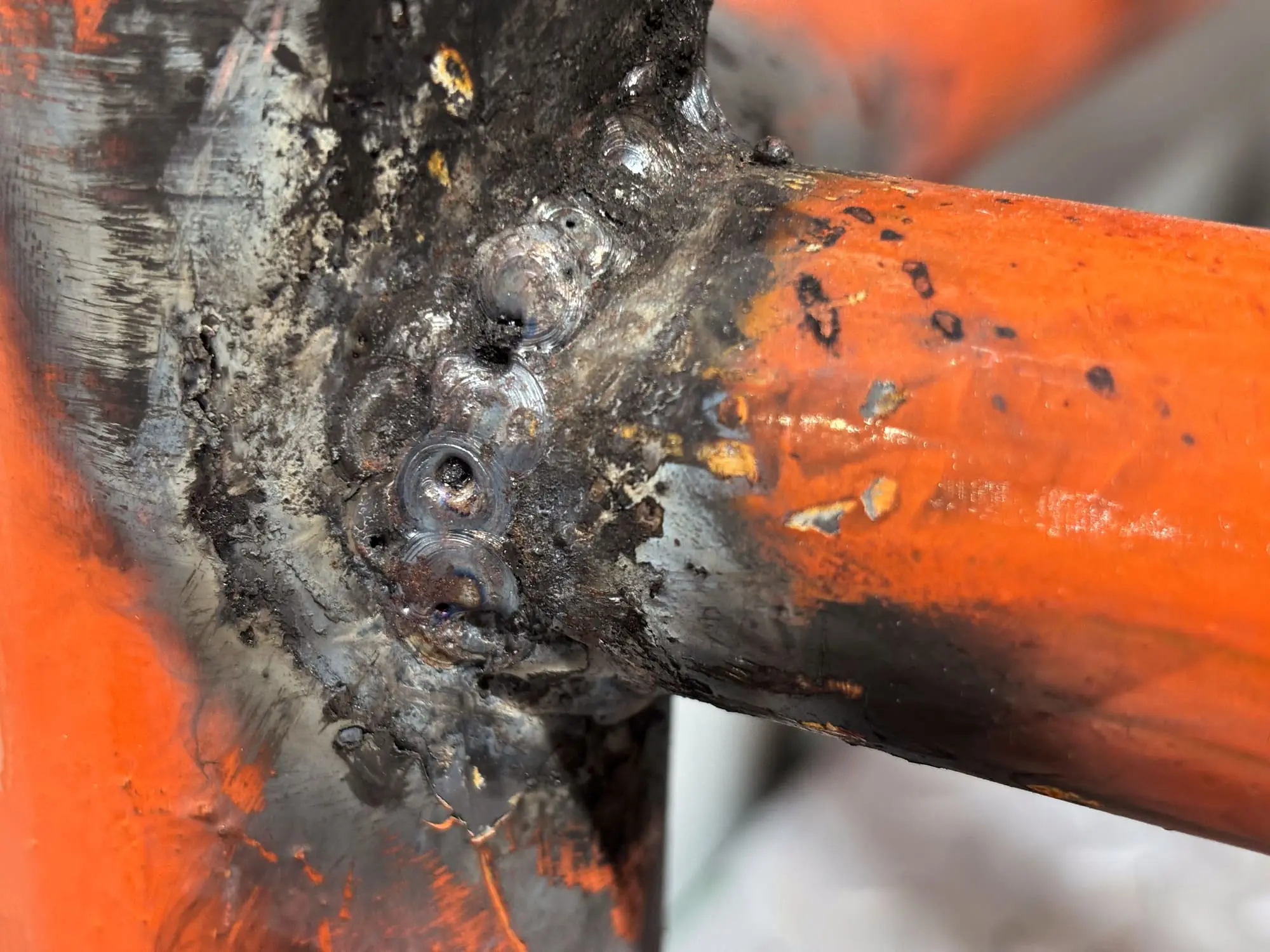
In the ideal world, every weld we set out to do turns out perfect: ideal fusion, high quality, no cracks or pores or imperfections. But in the real world, even an experienced welder can make mistakes. Let’s take a look at the types of defects you might encounter in your welds and the 7 most common mistakes that can cause them.
12 Types of Welding Defects
There are a lot of different ways that a bad weld can show up—some external and some internal. The site Weld Guru outlines different types of welding defects:
- Cracks — An internal defect where cracks form either parallel to the weld, across the width of the bead, or in a “crater” at the end of the weld.
- Slag inclusions — An internal defect where impurities are accidentally trapped inside a weld, which compromises its strength.
- Lack of fusion — An internal defect where the filler material doesn’t bond well with the base metal.
- Porosity — An external defect where gas bubbles are trapped inside the weld bead, weaking the joint.
- Undercut — An external defect where a groove or notch runs along the toe of the weld.
- Incomplete penetration — An internal defect where the weld bead doesn’t go all the way to the bottom of a butt joint.
- Burn-through — An external defect in the form of a hole in the metal caused by excessive heat.
- Under-fill — An external defect where the weld bead sits below the surface of the base metal.
- Excess reinforcement — An external defect where there’s too much filler material in the weld.
- Spatter — An external defect where small droplets of molten material scatter and stick to the surrounding material. Some spatter isn’t uncommon but can be classified as a defect if it’s excessive.
- Overlap — An external defect where the filler material flows over the base metal but doesn’t fuse with it properly.
- Whiskers — A MIG welding defect where short segments of the electrode wire protrude from the root side of the joint.
7 Common Welding Mistakes That Lead to Defects
The defects we’ve listed above are often caused by flaws or mistakes made by the welder during the process, so if you’re wanting to avoid issues and reworking, let’s take a look at the mishaps you should be aware of and avoid.
Skipping Metal Preparation
This one sits at the top of almost every list you can find of welding mistakes. Never assume the metal you’re working with is clean because even a small amount of dirt, oil, or other contaminants can impact the quality of your weld.
What to Do About It: Clean the metal thoroughly using a wire brush or grinder, plus acetone to eliminate oily residues.
Poorly Fitting Up Joints
Going hand-in-hand with preparing your metals, you need to take your time when it comes to the “fit-up,” where you adjust and align the pieces being welded together and tack them into place with clamps or jigs.
What to Do About It: Biggest thing is not to rush this step. Check your alignment from multiple angles. Ensure that the gap across the joint is even.
Implementing Incorrect Welding Techniques
This is kind of a broader topic, but there are a few specific areas in particular that you need to stay aware of: improper angles and uneven or incorrect speed. Holding your torch at an angle that’s too steep or too shallow can cause a variety of issues, including uneven penetration or poor fusion. If you’re moving your torch too fast, you’ll have weak penetration; too fast, and you’ll have excess or overlap; and inconsistently, you’ll weaken your weld or create too much heat.
What to Do About It: Take time especially during your training with practicing maintaining a steady hand and speed. Guides and templates can help as you’re beginning.
Not Controlling the Heat
Every material you work with and every type of weld is going to call for specific heat levels, and you need to stay aware of it at all times to avoid warping, burn-through, cracks, or fusion issues.
What to Do About It: If you’re new to welding or unsure, you can practice on a piece of scrap metal before starting on the actual weld in order to fine tune amperage and voltage.
Using the Incorrect Gas Flow Rate
With MIG and TIG welding that utilizes shielding gas, the right gas coverage can protect the weld puddle from atmospheric contamination. Incorrect gas flow can contribute to spatter or porosity and introduce contaminants.
What to Do About It: Always check your gas flow before you start and check it according to the guidelines. If needed, you can use a gas lens kit and back purging.
Short-Changing Cleanup
As busy as you might be, you should never skip your post-weld cleanup process. Removing slag, grinding down spatter, buffing the finish—it isn’t just about the aesthetics of the weld. It can also help you identify defects or imperfections that you might otherwise miss.
What to Do About It: Use a chipping hammer, wire brush, or grinder to get rid of slag, spatter, and rough edges. Perform a thorough post-weld inspection.
Not Taking Safety Seriously
Welding is an incredible career, but it’s not without its risks. Working with these kinds of tools and extreme heat that generates sparks and fumes, you can’t afford to take a shortcut with your personal safety.
What to Do About It: Prioritize always having all of your protective equipment, including a helmet with the correct shade lens, leather gloves, long-sleeved flame-resistant clothing, and steel-toed boots. Consider also things like welding respirators and ear protection.
Become a Professional Welder at VTI
At Vocational Training Institute, we have faculty with real-world experience who can help you train for and grow your career as a professional welder. Our focused, hands-on Welding training program is specifically designed to get you ready for a new job and a new future. If you’re ready to get started, register with VTI in Phoenix today.