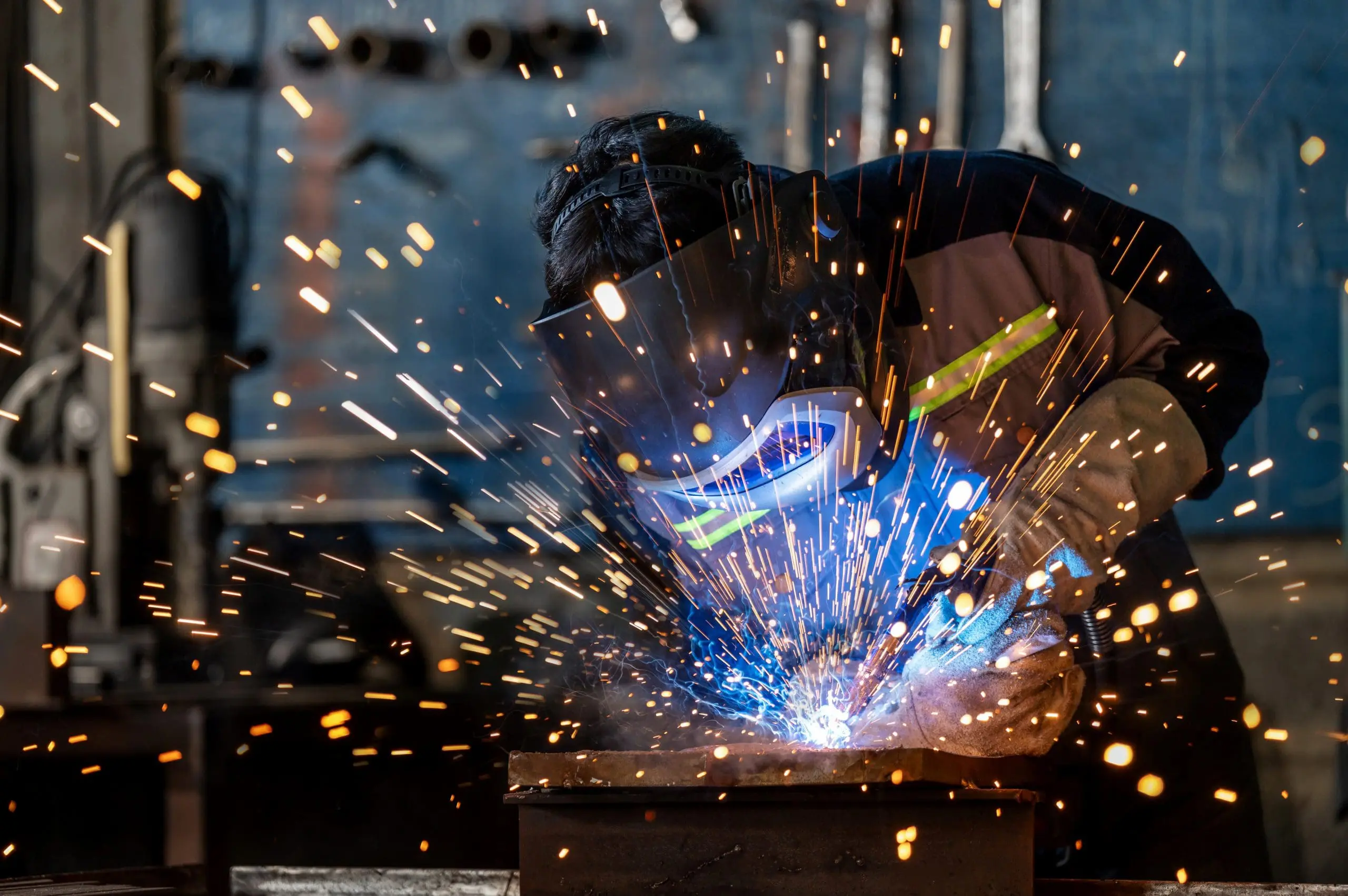
It’s 2026, and for the first time in fifty years, skilled trade workers have better employment outcomes than workers with bachelor’s degrees. With college tuition more expensive than ever and labor shortages in industries like construction and manufacturing, people looking for a stable career are turning to hands-on training in trade skills, like welding.
So how exactly do you become a professional welder in 2026? Let’s break it down.
What Do Professional Welders Do?
Welders train to use welding torches and other handheld equipment in order to join metals and alloys together, fill holes or indentations, or fix seams. The actual techniques and welding processes used vary depending on the metals you’re working with and the needs of the job, but in general, you can expect to do things like:
- Reading blueprints, sketches, and specifications and interpreting what is needed
- Inspecting structures or materials to be welded and then calculating and measuring the dimensions
- Performing welds according to blueprint specifications
- Monitoring the welding process and adjusting heat and techniques as necessary
Welding processes include MIG welding, TIG welding, stick welding, flux cord arc welding, plasma arc welding, laser beam welding, gas welding, automatic hydrogen welding, electroslag welding, and so on.
Is Welding a Good Career for 2026?
One of the major benefits of becoming a skilled welder is the versatility of this career because welders are needed in a wide variety of industries, like:
- Automotive and heavy equipment manufacturing
- Consumer goods fabrication
- Infrastructure and construction
- Aerospace manufacturing
- Shipbuilding and repair (underwater welding)
- Railyards and transportation
- Aviation maintenance
- Military and armed forces
According to the U.S. Bureau of Labor Statistics, retiring workers are going to contribute to an average of 45,600 openings for welders every year. The U.S., in particular, is seeing a rising need to repair and replace aging infrastructure, and welders will be a key part of that process. The BLS reports that the median wage for welders in May 2024 was $51,000, with the highest 10 percent earning more than $75,850.
A Step-by-Step Guide to Becoming a Professional Welder
Step 1: Do I Need a High School Diploma or GED to Get Started as a Welder?
There are a lot of welding training programs out there that do require you to have a high school diploma or GED, but not all of them do. Vocational Training Institute, however, doesn’t make that a requirement for acceptance into our Welding Training program.
Welders are required to do a lot of measuring and calculating, so some base knowledge of things like algebra and geometry/trigonometry can be beneficial. Knowing some essentials about chemical processes and basic physics can also give you a solid foundation going into the program.
Step 2: What Kind of Training Do I Need to Become a Welder?
The good news: you won’t have to waste tens of thousands of dollars and years in a classroom in order to become a welder. Instead, what you want to look for is an accredited career school that offers hands-on training in exactly the skills you need to find success in the welding workforce. Ideally, your welding trade schools will offer the opportunity to earn AWS (American Welding Society) Certification. VTI is one of the few in Arizona.
During your welding training, you will learn welding positions, techniques, and applications and other fundamentals. At VTI, our courses cover topics like:
- SMAW-Groove Welds
- OSHA 10 Safety
- Construction Drawings
- Communication and Employability Skills
- Oxyfuel Cutting
- Base Metal Preparations
- Weld Quality
- SMAW Electrodes, Beads, and Fillet Welds
- Joint Fit-Up and Alignments
- SMAW-Groove Welds
Step 3: What Happens After I Graduate from Welding Training?
Once you’ve successfully completed a welding training program, your next step is to enter into a paid apprenticeship. This allows you to start making money while you continue to improve on what you’ve learned and build more experience with job site safety, all under the oversight of experienced welding professionals.
Step 4: What Types of Certifications Do I Need as an Entry-Level Welder?
No welder can be hired onto a job without their OSHA certification, but if you’ve gone through a training program like VTI’s, that is integrated into the curriculum. Beyond that, however, employers will likely be looking for additional certifications that demonstrate your skills. A foundational one is the Welder Certificate Program from the AWS, which is designed to provide transferable credentials to professional welders who demonstrate the required skills. The test is performance-based and requires no prerequisites, and if you pass, you are considered an AWS Certified Welder.
Step 5: How Do I Advance in My Welding Career?
There are a long list of welding specializations and certifications that you can add to your skillset, each of which opens up new opportunities in your career. A large number of them are through AWS, including:
- Certified Welding Inspector (CWI), Certified Associate Welding Inspector (CAWI) and Senior Certified Welding Inspector (SCWI)
- Certified Welding Supervisor (CWS)
- Certified Welding Educator (CWE)
- Certified Welding Engineer (CWENG)
- Certified Resistance Welding Technician (CRWT)
- Certified Radiographic Interpreter (CRI)
- Certified Robotic Arc Welding (CRAW)
- Certified Welding Sales Representative (CWSR)
Additionally, there are certifications and continuing education opportunities through organizations like the American Petroleum Institute, the American Society of Mechanical Engineers, the Iron Workers, the EWI, and the Fabricators and Manufacturers Association.
Train to Become a Professional Welder at VTI
At Vocational Training Institute, we have faculty with real-world experience who can help you train for and grow your career as a professional welder. Our focused, hands-on Welding training program is specifically designed to get you ready for a new job and a new future. If you’re ready to get started, register with VTI in Phoenix today.