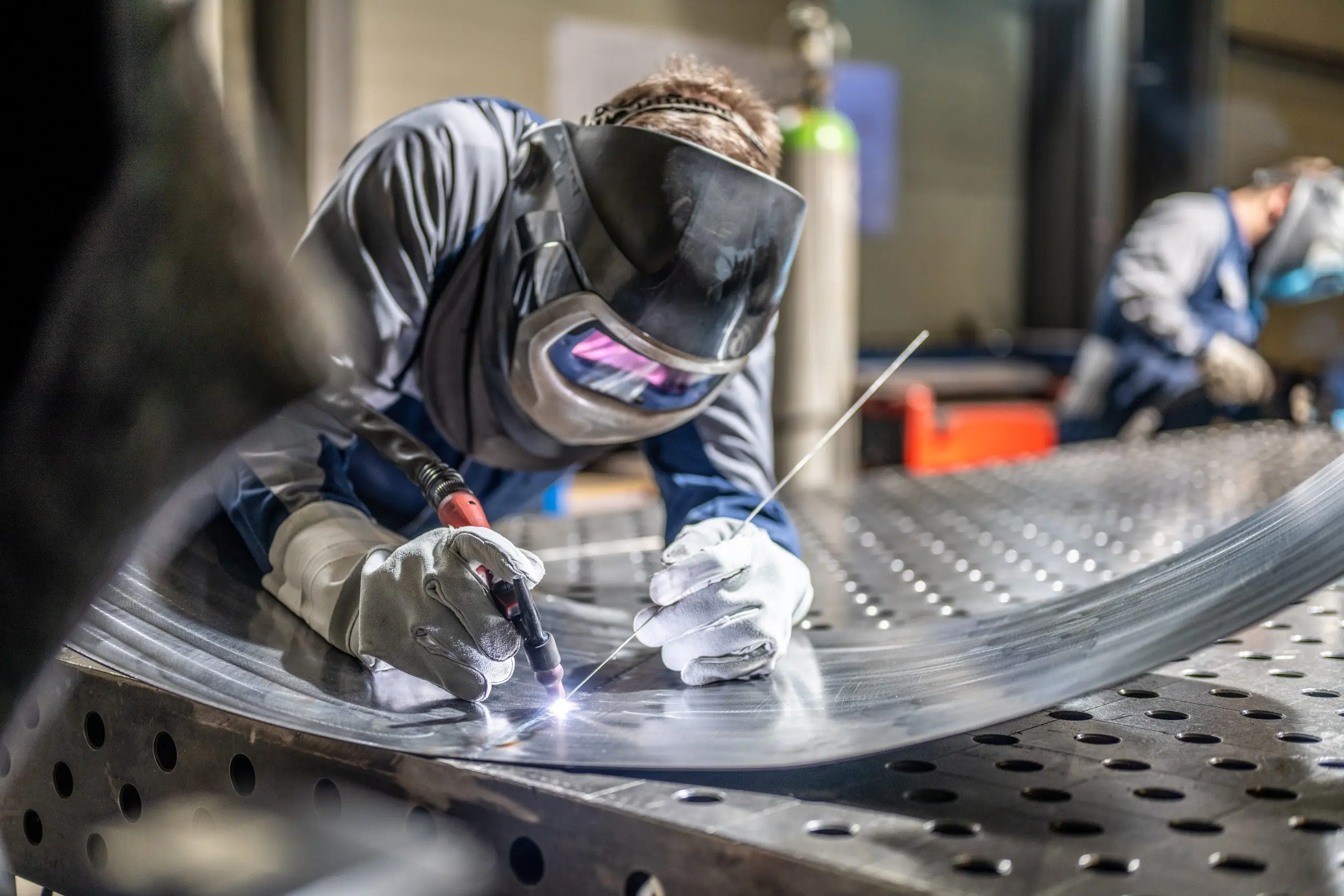
Welding is a highly versatile skill that is useful and necessary in many industries. At its most basic form, the craft involves joining two or more pieces of metal together using intense heat and pressure. This skill opens the door to several welding careers across many industries. From working on infrastructure like bridges to crafting artistic creations, the possibilities are as diverse as they are rewarding. According to the U.S. Bureau of Labor Statistics, there were 454,000 jobs for welders, cutters, solderers, and brazers earning a median salary of $48,940. The Bureau predicts the welding career field to grow about 2% by 2033.
If you enjoy working with your hands, assembling objects, and seeing metal transform into new machinery, a career in welding might be right for you. If you are unsure what a welding job could look like, we’ve compiled a list of five interesting welding career options, how long it takes to get into them, and the necessary training. What one suits you?
1. Structural Welder
Structural welders work on building frameworks for structures such as bridges, skyscrapers, and industrial facilities. They ensure the safety and stability of these structures by creating strong, durable welds that bond the materials together.
Time to Enter the Field:
4 to 9 months, depending on the program and certifications required.
Required Training:
- Completion of a welding certificate program, which typically includes training in basic and advanced welding techniques.
- Certification from the American Welding Society (AWS) as a Structural Welder.
- Familiarity with blueprints and safety standards for construction projects.
2. Pipefitter/Welder
Pipefitters specialize in welding and installing pipes that carry liquids or gases, commonly working in industrial plants, power facilities, and oil refineries.
Time to Enter the Field:
6 months to 1 year. Apprenticeships can take up to 5 years for advanced roles.
Required Training:
- A welding certificate program emphasizing pipe welding techniques, such as TIG (tungsten inert gas) or MIG (metal inert gas) welding.
- Industry-specific certifications, such as AWS Certified Pipe Welder or ASME (American Society of Mechanical Engineers) qualifications.
- On-the-job training through an apprenticeship program is highly beneficial.
3. Aerospace Welder
Aerospace welders work on aircraft, spacecraft, and related components. Precision and attention to detail are critical for this high-stakes role, as their work must meet stringent safety and quality standards.
Time to Enter the Field:
1 to 2 years, including specialized training.
Required Training:
- A welding certificate focusing on advanced techniques such as TIG welding for aluminum and titanium, commonly used in aerospace.
- Certifications from AWS, such as the Certified Welding Inspector (CWI) or endorsements for aerospace applications.
- Additional coursework or training specific to aerospace materials and fabrication standards.
4. Underwater Welder
Underwater welders combine welding expertise with commercial diving skills to repair and build structures submerged in water. They work on projects such as offshore oil rigs, ships, pipelines, and underwater infrastructure. This challenging and lucrative career demands physical stamina, technical precision, and safety awareness.
Time to Enter the Field:
1 ½ to 2 years, including specialized training.
Required Training:
- Completion of a welding certificate program, including the shielded metal arc welding (SMAW) technique, commonly used in underwater welding.
- A Commercial Diving Certification, which usually last 5 -12 months
- Specialized underwater welding training.
Specialized certifications, such as the AWS Certified Underwater Welder and diving-specific certifications through organizations like the Association of Diving Contractors International.
5. Artistic Welder
For creative individuals, welding can lead to a career in metal art and sculpture. These welders create decorative gates, furniture, and public art installations.
Time to Enter the Field:
3 to 9 months, plus time to build a portfolio.
Required Training:
- A basic welding certificate program that includes artistic metalworking techniques like forge welding and plasma cutting.
- Additional courses in art and design, often available through community colleges or specialized programs.
- Experience in a workshop or under a professional metal artist to hone skills and gain industry insights.
Get Your Welding Career Started Today
A welding certificate can open the door to a range of fulfilling careers, each offering unique challenges and opportunities. To get an even greater idea of jobs available in the field, AWS has an online job search page. Vocational Training Institute in Phoenix, Ariz., offers several welder training programs. For those interested in pipefitting or other careers that require MIG training an enroll in one of our 20-hour, weekend MIG courses.
Whether you are drawn to building structures, shaping industrial pipelines, crafting intricate components, or creating artistic masterpieces, welding provides a hands-on pathway to success. By investing time in training and certifications, aspiring welders can position themselves for rewarding careers that not only offer financial stability but also the satisfaction of seeing their work come to life in tangible ways. Contact VTI for more information.